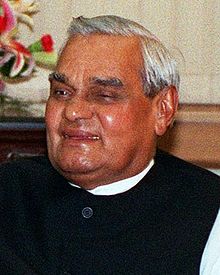
It is very sad to listen and see that honourable Atal Bihari Vajpayee who served as Prime Minister for three terms (first for a term of 13 days in 1996, then for a period of 13 months from 1998 to 1999, and finally, for a full term from 1999 to 2004) is now no more.
A member of the Bharatiya Janata Party (BJP), he was the first Indian prime minister who was not a member of the Indian National Congress party to have served a full five-year term in office.
He was a member of the Indian Parliament for over four decades, having been elected to the Lok Sabha, the lower house, ten times, and twice to the Rajya Sabha, the upper house. He served as the Member of Parliament for Lucknow, Uttar Pradesh until 2009 when he retired from active politics due to health concerns. Vajpayee was among the founding members of the Bharatiya Jana Sangh (BJS), of which he was the president from 1968 to 1972. The BJS merged with several other parties to form the Janata Dal, which won the 1977 general election. Vajpayee became the Minister of External Affairs in the cabinet of Prime Minister Morarji Desai. He resigned in 1979, and the Janata alliance collapsed soon after. The erstwhile members of the BJS formed the BJP in 1980, with Vajpayee as its first president.
During his tenure as prime minister, India carried out the Pokhran-II nuclear tests in 1998. Vajpayee sought to improve diplomatic relations with Pakistan, travelling to Lahore by bus to meet with Prime Minister Nawaz Sharif. After the 1999 Kargil War with Pakistan, he sought to restore relations through engaging with President Pervez Musharraf, inviting him to India for a summit at Agra.
He was conferred India’s highest civilian honour, the Bharat Ratna, by the President of India, Pranab Mukherjee in 2015. The administration of Narendra Modi declared in 2014 that Vajpayee’s birthday, 25 December, would be marked as Good Governance Day. He died on 16 August 2018 due to age-related illness.
Early Access and Education
Vajpayee was born to Krishna Devi and Krishna Bihari Vajpayee on 25 December 1924 in Gwalior. His grandfather, Pandit Shyam Lal Vajpayee, had migrated to Morena, Gwalior from his ancestral village of Bateshwar, Uttar Pradesh. His father, Krishna Bihari Vajpayee, was a school teacher in his hometown. Vajpayee did his schooling at the Saraswati Shishu Mandir in Gwalior. He subsequently attended Gwalior’s Victoria College (now Laxmi Bai College) and graduated with distinction in Hindi, English and Sanskrit. He completed his post-graduation with an M.A. in Political Science from DAV College, Kanpur, and was awarded a first-class degree.
His activism started with Arya Kumar Sabha of Gwalior, the youth wing of the Arya Samaj, of which he became the general secretary in 1944. He also joined the Rashtriya Swayamsevak Sangh (RSS) as a swayamsevak, or volunteer, in 1939. Influenced by Babasaheb Apte, he attended the Officers Training Camp of the RSS during 1940–44 and became a pracharak, RSS terminology for a a full-time worker, in 1947. He gave up studying law due to the partition riots. He was sent as a vistarak, a probationary pracharak, to Uttar Pradesh and quickly began working for the newspapers of Deendayal Upadhyaya, Rashtradharma (a Hindi monthly), Panchjanya (a Hindi weekly) and the dailies Swadesh and Veer Arjun.

 Priyanshu's blog